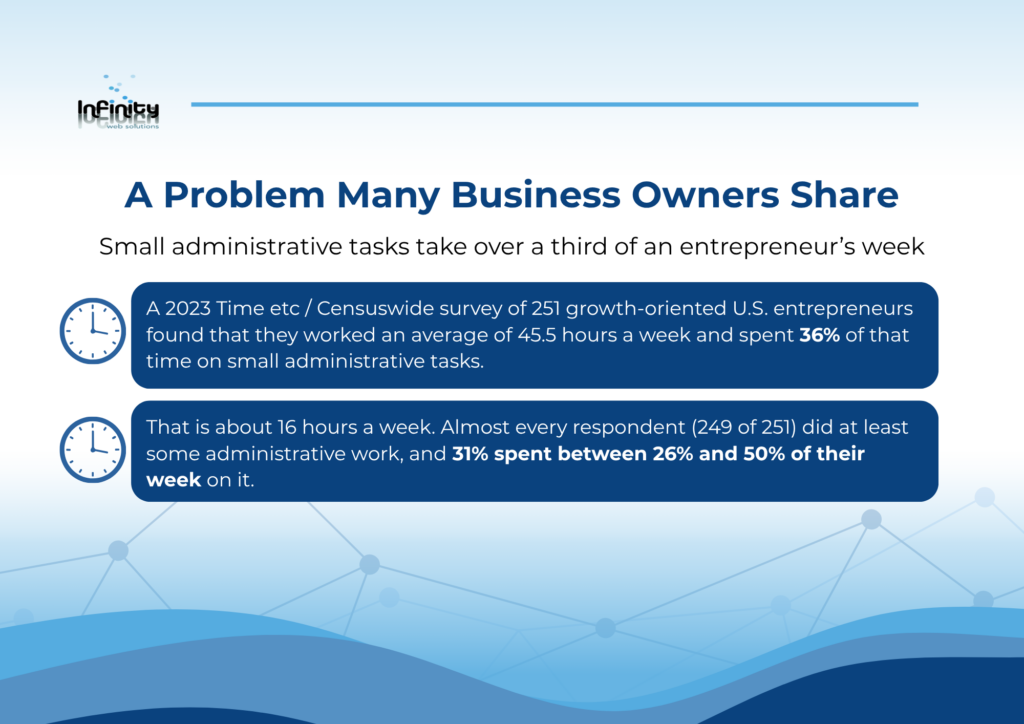
Small, repetitive tasks are a common source of lost productivity for growing businesses. Email management, calendar management, and data entry take only a few minutes each. So do prospect research, outreach messages, and client follow-ups. Over a full week, they add up to a large share of the owner’s working hours.
These tasks had crept into most of the owner’s day. Emails, spreadsheet updates, and follow-ups got done in whatever gaps there were. As such, strategy and client relationships were left with what little time remained. Outreach was patchy, and the backlog kept growing.
To address this, a client turned to virtual assistant services and assigned a dedicated virtual assistant to take over the recurring workload. The VA organized daily workflows and documented recurring tasks. The VA also handled email and calendar management, data entry, prospect outreach, and client follow-ups, which gave the business the administrative support it needed to streamline its daily operations.
This case study covers the challenge, the approach, and the results. It looks at time savings, task completion, and operational efficiency.
Client Overview
The client is a software company that provides a product information management (PIM) platform for eCommerce businesses. The platform helps growing online sellers manage product data in one place. This includes descriptions, attributes, and images across multiple sales channels.
It is built for businesses that have outgrown spreadsheets and manual processes. These businesses want a simpler option than an enterprise-level platform.
The client serves growing eCommerce companies with expanding product catalogues. Their customers sell across marketplaces and online stores, and they need consistent, accurate product information on every channel. Outreach is how the client reaches these companies, starts conversations with prospective customers, and supports business growth.
The Challenge
Prospect research and outreach take time. This includes finding prospects, sending messages, and following up with those who have not replied. The team also had other work to do. They were developing the product and managing relationships with customers who had replied, shown interest, or were already using the product.
Product development and customer relationships came first, so outreach was done when time allowed. Managing tasks and time across all of these priorities was difficult. Research on new prospects slowed down. Messages went out less often, and follow-ups were sent late or not at all.
The client needed a way to keep outreach consistent without taking time away from product development and customer relationships.
Our Approach
Infinity Web Solutions approached this engagement by first understanding what the client wanted from their outreach. The team’s goal was to make sure every outreach activity supported the client’s objective of starting conversations with eCommerce businesses that could benefit from their product.
Before any messages went out, the team discussed the client’s requirements, the scope of work, and how the outreach would be managed.
Understanding the Client’s Objectives
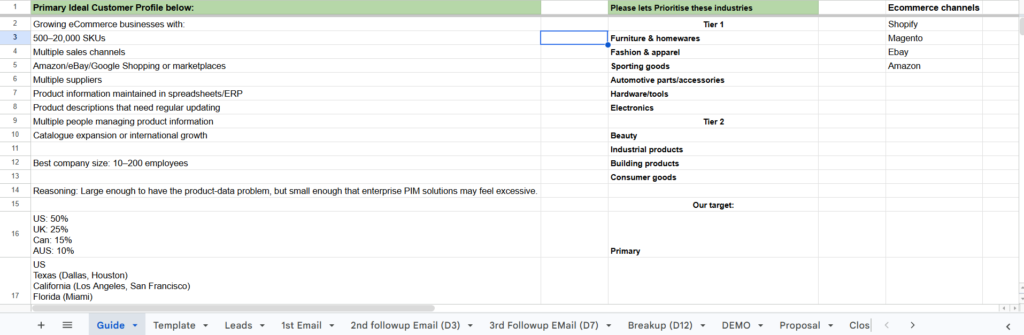
The team learned about the client’s product, their target customers, and the kind of conversations they wanted to start. This included reviewing their approved email template and the type of eCommerce businesses they wanted to reach.
These discussions set the direction for prospect research and ensured that each message matched the client’s goals.
Discussing the Working Arrangement
Once the client’s requirements were clear, the team agreed on the scope of work, responsibilities, working schedule, and communication arrangements. A dedicated virtual assistant was assigned to the account to handle prospect research, outreach messages, and follow-ups.
Each recurring task was documented step by step. This brought workflow organization to the process and gave the work a clear structure. The documentation served as the basis for workflow management on the account, and it made the process easy to review or adjust as part of ongoing business process optimization.
Keeping the Client Involved
Updates went to the client as the work progressed. Replies from interested prospects were forwarded to their team, and they took over from there.
The client also had the chance to review the work and share feedback, particularly in the early stages. This helped the team confirm that the outreach met their expectations.
Services Provided by Infinity Web Solutions
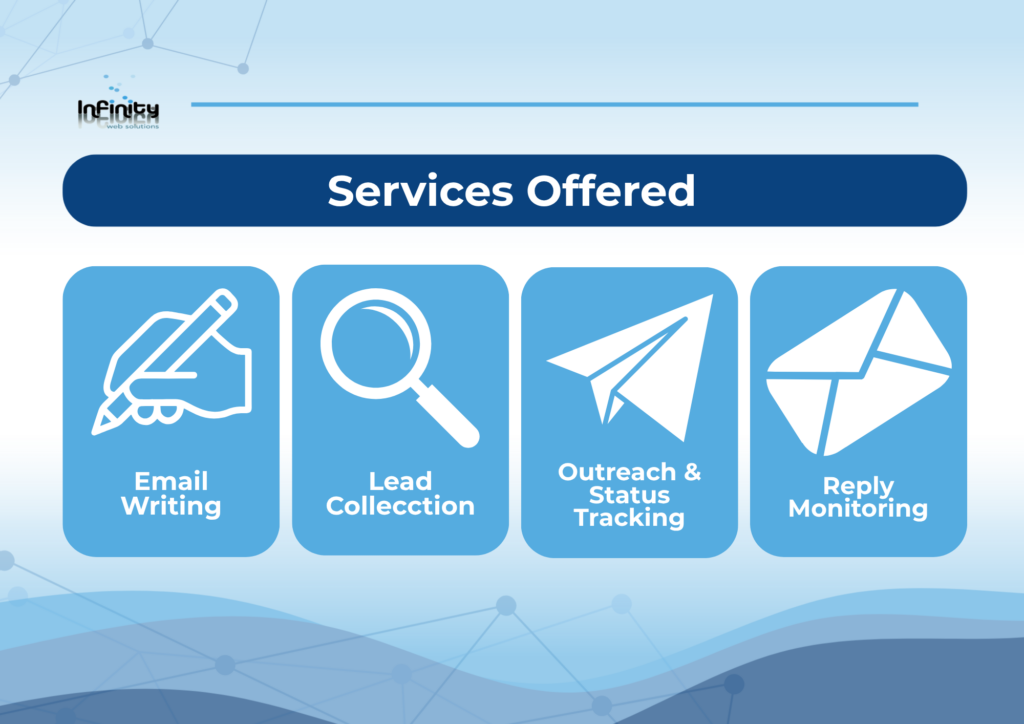
The dedicated virtual assistant (VA) took on the client’s outreach from the first template to the last follow-up. Working as a remote administrative assistant, the VA gave the team administrative support in three areas: message templates, lead collection, and outreach management. The result was one process for reaching eCommerce businesses, with a record of every conversation.
Message Templates
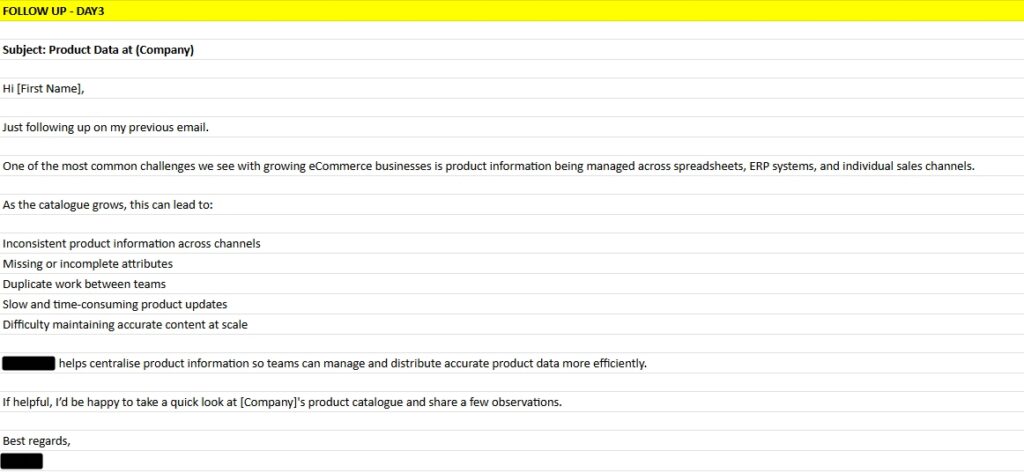
Each stage of the sequence had its own template, written before any messages went out. The client could read through the wording first and ask for changes.
- Email: Initial contact. Introduces the client’s product and asks whether the prospect is open to a conversation.
- Email: Follow-up (Day 3). Sent to prospects who had not replied to the first email.
- Email: Follow-up (Day 7). A second reminder, sent if there was still no response.
- Email: Breakup (Day 12). The last email in the sequence. After this, the prospect was not contacted again.
- LinkedIn message. Reaches the prospect on a second channel alongside email.
- Email after LinkedIn acceptance. Continues the conversation once the prospect accepts the connection request.
Lead Collection
The VA looked for growing eCommerce businesses that sold across multiple channels and matched the client’s target profile. Each one was entered on a shared sheet with these details:
- Contact person’s name: who the message was addressed to
- Contact person’s email: where the email sequence was sent
- Contact person’s title: confirmed that the VA was reaching someone relevant to the decision
- Industry: the business’s industry
- Location: where the business is located
- Website: the company’s online store or main site
- LinkedIn profile: the company or contact person’s profile, used for LinkedIn outreach
Lead collection was ongoing. The VA kept finding and adding new prospects to the sheet while outreach was underway, so the list was refreshed continuously as messages went out. This meant there was always a new group of prospects ready to enter the sequence.
Keeping all of this in one place gave the team a clear list to work from. The VA could address each message to the right person, and the team could see who was being contacted at any point.
Outreach and Status Tracking
The VA contacted each prospect using the approved templates. Before sending, the VA personalised each email to the prospect. This included, but was not limited to, addressing the contact person by name and referring to their company, so the message read as written for that company.
The VA updated each prospect’s status on the sheet after every message. Anyone on the team could open it and see who had been contacted, who had replied, and who was next in line for a follow-up.
Reply Monitoring and Follow-Ups
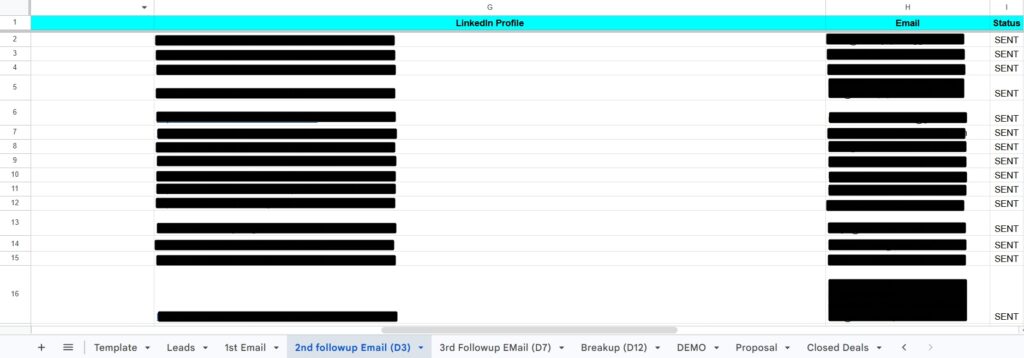
The VA handled email management for the campaign by monitoring for replies and sending status updates to the client, so the team knew when a prospect responded. For prospects who had not replied, the VA sent or scheduled follow-ups following the Day 3, Day 7, and Day 12 sequence. This removed the need for anyone on the team to remember who was due for a message.
Managing Not-Interested Prospects
When a prospect said they were not interested, the VA moved them to a separate sheet. This kept them from being contacted again by mistake. It also kept the main list limited to prospects who were still active, which made the sheet easier to work from.
Results and Business Impact
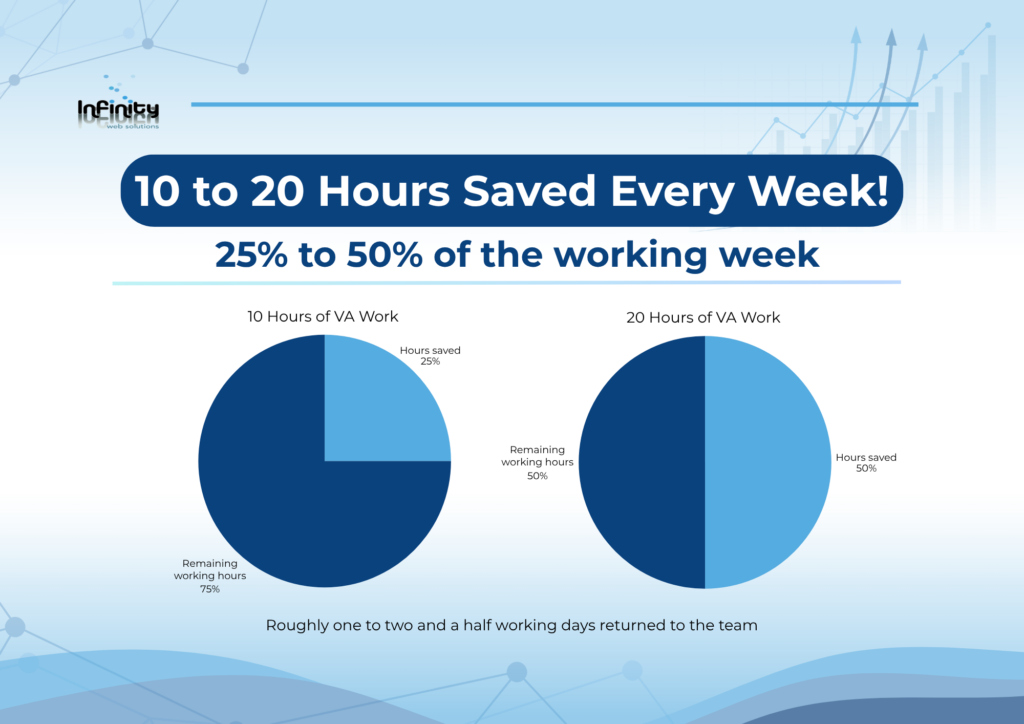
The engagement gave the client an outreach process that ran daily without depending on the team’s spare time. It increased productivity across the team and gave the business dependable business operations support.
10 to 20 Hours Saved Each Week
By taking over the outreach workload, the VA saved the client’s team 10 to 20 hours every week. Outsourcing prospect research, messaging, follow-ups, and reply monitoring to a virtual assistant meant the work no longer needed the team’s attention. The team put that time into product development and their customers.
Consistent Delivery
Every prospect went through the same sequence on the same days. The templates and documented steps were set in advance, so messages went out when planned. Follow-ups happened even in weeks when the team was busy with the product and customers, and nobody had to decide what to send or when.
Clearer Records
The sheet showed each lead’s status, so the team did not have to ask where a prospect stood. Prospects who declined were moved off the active list, which meant nobody was contacted twice.
Continuous Lead Flow
Prospecting never paused while outreach was running. New leads were added alongside the messages going out. As a result, outreach did not stall when one batch of leads was used up. The team did not have to stop and rebuild a list each time one ran out, which kept the work moving and saved them from repeated start-and-stop research.
Greater Focus for the Team
Replies and interested prospects were passed to the team through the VA’s status updates. This allowed the team to respond to interested prospects directly, without sorting through unanswered messages first. It improved operational efficiency across the business, and the team could give more attention to the product and existing customers.
Key Takeaways & Strategic Value
The client is a software company that needed consistent outreach while its team worked on the product and supported customers. A dedicated virtual assistant (VA) took over that work. The points below cover what the partnership gave the client.
Key Takeaways
- The team got 10 to 20 hours back each week. Time that would have gone to prospect research, messaging, and follow-ups went to product development and existing customers.
- Outreach kept running alongside the team’s other work. Messages and follow-ups went out on schedule, and new prospects were added throughout, so outreach no longer depended on how busy the team was.
- The team could see where each prospect stood from the shared sheet and the VA’s status updates, without keeping track of it themselves.
- The team spoke only to prospects who had replied. The VA handled the first contact, the follow-ups, and the sorting, and the team took over once a prospect showed interest.
Strategic Value
Outreach is how the client starts conversations with prospective customers. The partnership allowed the client to keep that going without taking the team away from the product or the customers already using it. The client now has a documented process and a record of every prospect contacted. They can use both to reach more prospects and support business growth.
Get Your Time Back with a Dedicated Virtual Assistant from Infinity Web Solutions
Business owners lose hours each week to tasks that need to be done but do not need their direct attention. When those hours go back to the business, productivity goes up. This case study shows how to streamline daily business operations by handing recurring work to a virtual assistant. A dedicated virtual assistant saved the client’s team 10 to 20 hours every week, and that time went to the product and the customers already using it.
Infinity Web Solutions offers virtual assistant services for business owners. Our team takes on recurring work, documents how it is done, and keeps it running day after day, so you can focus on what moves your business forward.
Contact Infinity Web Solutions today to talk about where your time is going and how we can help you get it back.